
 English
 Indonesian
 简体字
简体字
 العربية
 Español
 Français
 Português
 日本語
日本語
 한국어
한국어
 Tiếng Việt
Sign In to Continue
To view and access the document, you are required to sign in to your account first.
Don't have an account? Sign Up Here
Home Stearic Acid Market 2025: Supplier & Distributor Strategies
Supply Chain | 16 June 2025
Stearic Acid Market 2025: Supplier & Distributor Strategies
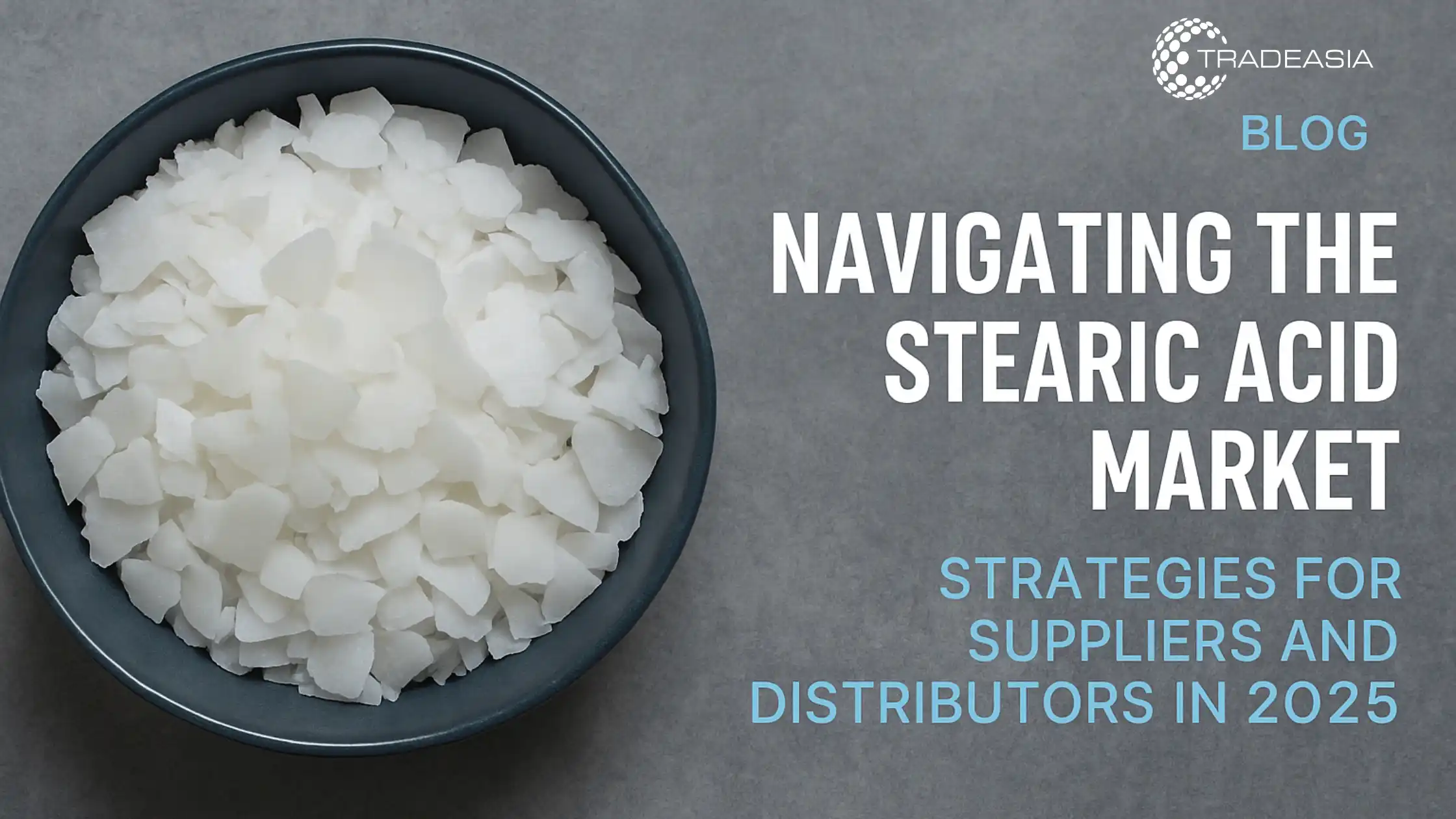
Table of Content
- Introduction: New Complexities in a Mature Market
- Strategic Sourcing: Build Redundancy, Not Dependency
- Regional Distribution: Go Where the Demand Grows
- Localized Warehousing and Lead Time Reduction
- Differentiation Through Product Portfolio & Service
- Data-Driven Pricing and Market Intelligence
- Digital Sales Channels and Buyer Portals
- Conclusion: Staying Agile in a Shifting Market
Introduction: New Complexities in a Mature Market
In 2025, global stearic acid trade faces rising complexity amid volatile raw material pricing, supply chain disruptions, and increasing regulatory scrutiny on sustainability. Suppliers, distributors, and resellers must move beyond traditional procurement and embrace data-driven strategies, multi-source resilience, and differentiated offerings to remain competitive.
According to recent forecasts, the global stearic acid market is projected to grow at a CAGR of 4.8% through 2027, with Asia-Pacific contributing the largest share of production and consumption due to its robust oleochemical infrastructure and consumer product demand (Source: Grand View Research, 2024).
Strategic Sourcing: Build Redundancy, Not Dependency
A. Source Diversity Reduces Risk
Modern traders should diversify sourcing portfolios across multiple feedstocks — including palm-based oleochemicals (predominant in Malaysia and Indonesia) and tallow-based stearic acid (common in the EU and North America).
India, Indonesia, and Malaysia remain the dominant global exporters, but relying solely on palm oil-based supply can introduce volatility due to deforestation regulations (e.g., EU EUDR), geopolitical disruptions, and seasonal yields.
Traders should develop alternate sourcing agreements in both tropical and temperate feedstock zones to balance product availability with client-specific formulation demands (e.g., vegan vs. animal-derived).
B. Procurement with ESG Filters
More manufacturers, especially in pharmaceuticals and personal care, require RSPO-certified or Kosher/Halal stearic acid. Suppliers must validate sustainability credentials from producers and offer traceable documentation, including:
COA (Certificate of Analysis)
Sustainability declarations (RSPO, ISO 14001)
Batch-level product origin tracking
Regional Distribution: Go Where the Demand Grows
A. Asia-Pacific and the Middle East: Hotspots for Expansion
The Asia-Pacific region, particularly China, India, and Vietnam, drives volume demand across rubber, plastics, and food industries.
The Middle East is emerging as a key downstream market due to its expanding industrial base and growing demand for stearates in detergents and personal care.
Localized Warehousing and Lead Time Reduction
Distributors that maintain in-region warehousing hubs can drastically improve lead times, especially in price-sensitive sectors like FMCG, textiles, or adhesives.
Key strategies include:
-
Partnering with 3PL (third-party logistics) providers in Dubai, Shanghai, or Chennai
-
Offering flexible MOQ (minimum order quantity) models to serve SMEs
-
Implementing regional pricing models to accommodate currency and shipping variances
Differentiation Through Product Portfolio & Service
A. Offer Multiple Grades and Purity Levels
Different end-user industries require stearic acid of varying purity and certification:
-
Technical Grade: Rubber vulcanization, candle manufacturing
-
Pharma Grade: Tablet coating, emulsifiers
-
Food Grade: Food-safe lubricants, confections, baking release agents
Maintaining grade variety improves customer retention and opens cross-sector opportunities.
B. Quality Documentation as a Service
Providing complete documentation per batch — including:
-
SDS (Safety Data Sheet)
-
COA
-
TDS (Technical Data Sheet)
-
Traceability charts
— improves customer confidence, reduces risk, and fulfills ISO 9001 procurement standards.
Data-Driven Pricing and Market Intelligence
A. Monitor Feedstock Trends
Pricing of stearic acid is closely tied to crude palm oil (CPO) and animal fat tallow prices. Traders should integrate real-time commodity tracking to optimize bulk purchase decisions.
B. Competitor Benchmarking
Platforms like ChemOrbis, ICIS, and Platts offer regional price indexes that allow traders to:
-
Benchmark margins
-
Identify arbitrage opportunities
-
Forecast demand cycles in key industries like detergents or cosmetics
Digital Sales Channels and Buyer Portals
To expand reach and streamline operations:
-
Launch self-service buyer dashboards for quoting, COA download, and order tracking
-
Leverage B2B marketplaces like Alibaba, TradeIndia, ChemNet, or LookChem for inbound traffic
-
Integrate with ERP and CRM systems for real-time inventory management and customer follow-up
Conclusion: Staying Agile in a Shifting Market
The stearic acid trade in 2025 demands resilience, agility, and insight. Suppliers and distributors who invest in flexible sourcing, regional logistics, and value-added services such as documentation and product differentiation will be best positioned to capture long-term market share.
By staying globally connected but regionally responsive, traders can adapt to price shifts, regulatory requirements, and customer expectations in real time — ensuring not only survival but sustainable growth in a competitive chemical landscape.
As one of the leading chemical supply chain companies in the world, Tradeasia International has been providing raw chemicals for various industries globally. We offer Stearic Acid and many other products, we are here to fulfill your specific business needs. To learn more about us and our products, contact our sales representatives. We are here to support you in finding the best solutions for your requirements.
Tags
Most Popular Insights
Most Popular Insights
Don't miss out on our updates!
Subscribe to our newsletter now
We're committed to your privacy. Tradeasia uses the information you provide to us to contact you about our relevant content, products, and services. For more information, check out our privacy policy.